


Six Weeks of Pain, a Stack of Bills, and No One Returning Your Calls
A roofer I’ll call Marcus fell from a second-story scaffold in late October. He reported it the same day, went to the ER, and did everything right. Three weeks later, a claim denial letter arrived saying his injury was “not work-related” because a supervisor had written in the incident report that Marcus “appeared unsteady before the fall” — language that quietly suggested intoxication without saying it outright.
Marcus called me convinced he had no case. He’d already told his wife they might lose the house.
He had a very strong case. The denial was built on a four-word phrase his employer inserted into a form he never saw.
What You Assume vs. What’s Actually Happening
Most workers who call me after a denial are operating on the same belief: the insurance company reviewed the facts and made a final decision.
That’s not what happened.
What actually happened is that an insurance adjuster received a file, reviewed the employer’s incident report, looked at the timeline, and found a reason — sometimes a thin one — to issue a denial. That denial letter is not a court ruling. It is an administrative decision made by a private company, and it is appealable.
The workers’ compensation system in most states is specifically designed with this in mind. Denials are expected. The appeals process exists because initial claim decisions are frequently wrong, incomplete, or shaped by one-sided documentation. Claims navigation research consistently shows that injured workers struggle most not because their injuries aren’t real, but because they don’t understand that the first denial is often just the opening move.
The gap between what workers assume and what a boston construction site injury lawyer would actually evaluate is enormous. Workers see a denial as a verdict. Experienced legal advocates see it as a document with specific vulnerabilities — and specific deadlines.
Decoding the Denial Letter
The denial letter is the most important document you have right now. Most people read it once, feel sick, and set it aside.
Read it again. Slowly.
Every denial letter is required to state the specific reason for the denial. That reason matters enormously — it tells you exactly what the insurer believes is missing or disputed. The four most common denial reasons in construction injury claims each point to a different problem requiring a different solution:
| Denial Reason | What It Means | What You Need |
|---|---|---|
| Injury “not work-related” | Insurer disputes the connection to your job | Medical evidence, witness statements |
| Filed outside reporting deadline | Claim submitted too late under state rules | Documentation of when you knew the injury was occupational |
| Employee vs. independent contractor | Insurer argues you weren’t covered | Payroll records, tax documents, proof of how the work relationship functioned |
| Insufficient medical evidence | Records don’t support claimed disability level | Treating physician opinions, independent medical evaluation |
Lumping these together and assuming the case is over is the mistake I see most often. Each category has a path forward — but only if you identify which one you’re actually dealing with.
The denial letter will also contain an appeal deadline. In most states, you have somewhere between 20 and 90 days from the denial date to file a formal appeal. That window closes hard. I’ve had workers call me on day 91, and there is very little I can do at that point except explore alternative theories of recovery. Don’t let that be you.
How the Insurance Adjuster Built the Record Against You
Here’s something most workers don’t realize until it’s too late.
The insurance adjuster who called you in those first few days after your injury — the one who sounded helpful, asked how you were feeling, and wanted to “get your statement” — was building a file that would be used to evaluate your claim. That’s not conspiracy. That’s their job. But it means the early recorded statement you gave, the way you described the accident, the offhand comment about a pre-existing knee problem — all of it is in the record now.
Adjusters are trained to listen for inconsistencies, prior injuries, gaps in treatment, and anything that suggests the injury happened off the job.
The employer’s incident report feeds into this same file. Supervisors often fill out these reports without the injured worker present, and the language they choose — “worker was not following safety protocol,” “employee reported feeling fine initially,” “no witnesses present” — can quietly undermine a legitimate claim before anyone files anything.
Injury trend data shows a notable uptick in injuries among older workers aged 60 and above, a group that’s particularly vulnerable to having pre-existing conditions cited as the “real” cause of an injury. An adjuster who knows a 62-year-old roofer has a history of back treatment will lean hard on that history when the worker falls from a ladder.
Comparing what the adjuster’s file contains versus what the actual medical and witness evidence shows is often where a denied claim gets reversed. The two pictures don’t always match.
The Appeals Board: What It Is and How It Works
The appeals board — sometimes called the Workers’ Compensation Appeals Board, or WCAB — is the administrative tribunal that hears disputes when a claim is denied. It is not a civil court. The rules of evidence are different, the timelines are compressed compared to civil litigation, and you don’t need to prove your case beyond a reasonable doubt.
The process moves through distinct stages:
- File a formal appeal (or Application for Adjudication of Claim) within the deadline in your denial letter — this opens the case at the board level
- Exchange evidence — medical records, the employer’s incident report, witness statements, any surveillance or recorded statements the insurer obtained
- Attend a mandatory settlement conference — both sides and a judge attempt to resolve the dispute without a full hearing
- Proceed to trial if settlement fails — a workers’ compensation judge reviews the evidence, hears testimony, and issues a decision
State-level claims data reflects how many of these disputes move through the system — and the volume makes clear that contested claims are routine, not exceptional.
The critical thing to understand is that the appeals board is where medical evidence becomes decisive. The insurer’s position at the denial stage was based on whatever was in the file at that moment. New medical evaluations, treating physician opinions, and independent medical examinations can shift the record significantly. A denial based on “insufficient medical evidence” often collapses when a proper medical-legal report is introduced.
“But I Reported Late” — And Other Reasons Workers Give Up Too Soon
I hear this constantly.
“I didn’t report it right away because I thought it would get better.” Or: “I didn’t want to make trouble.” Or: “My foreman told me to just take a few days off and see how it went.”
Late reporting is a real issue, but it is not automatically fatal to a claim. Most states allow workers to explain the delay, and if the explanation is reasonable — you didn’t know the injury was serious, your employer discouraged reporting, you were hospitalized — the late filing can often be excused. The question is whether you can document why the delay happened.
The other objection I hear is from workers who blame themselves. “I was rushing.” “I should have checked the harness.” Comparative fault thinking is natural, but workers’ compensation in most states is a no-fault system. You don’t lose your benefits because you made a mistake. Moving fast on a job site is not disqualifying. You lose benefits if the injury wasn’t work-related, if you were intoxicated, or if you intentionally caused your own injury — and those are narrow categories.
What to Do Right Now, In Order
If you’re holding a denial letter, sequence matters more than speed.
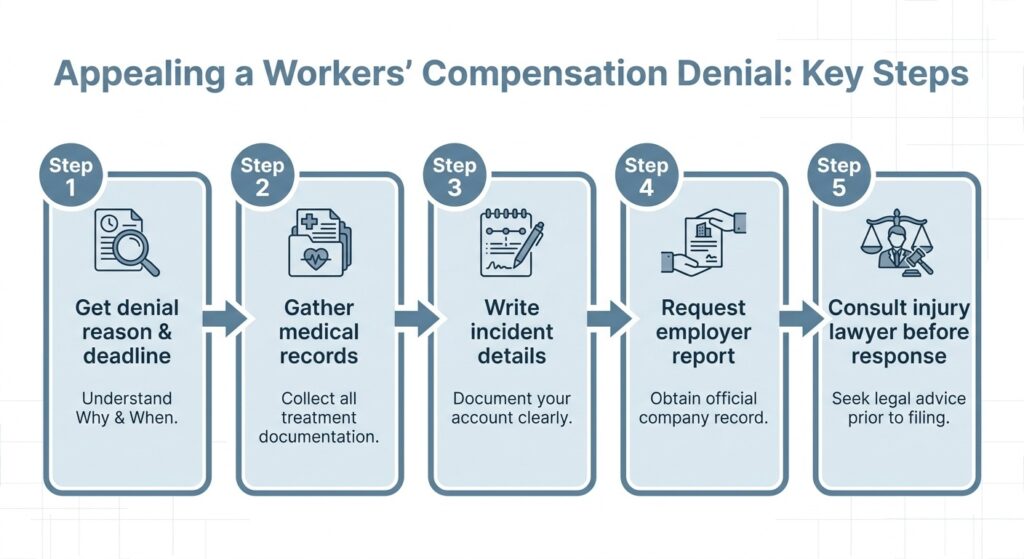
Step 1: Get the denial reason in writing and note the appeal deadline. If the letter is vague, request clarification in writing. Every day you wait is a day off your deadline clock.
Step 2: Pull together your medical records. Every ER visit, every follow-up, every prescription. If there are gaps in your treatment — weeks where you didn’t see a doctor — be prepared to explain them. Gaps get used against you.
Step 3: Write down everything you remember about the incident. Names of anyone who was present. What you were doing, what equipment was involved, what your supervisor said afterward. Do this now, while it’s fresh, before you talk to anyone else.
Step 4: Request a copy of the employer’s incident report. You have a right to this in most states. Read it carefully and note anything that doesn’t match your recollection. Discrepancies between your account and the employer’s report are often where a case turns — the way Marcus’s case turned on four words a supervisor wrote on a form he never saw.
Step 5: Consult a construction injury lawyer before you respond to the insurer. Not after. Before. Anything you say to the adjuster at this stage goes into the record.
The workers’ compensation system is adversarial at the denial stage, even when everyone is being polite. The adjuster is not your advocate. The employer’s HR department is not your advocate. The only person in that process whose job is to represent your interests is the attorney you hire.
A denial is not the end. It’s the beginning of a different, more deliberate fight — and most of the time, it’s a fight that can be won.