


The Attorney Who Signed You Up and the Attorney Who Works Your Case Are Often Two Different People
What if the person who convinced you to hire a firm never touches your file again?
That question keeps coming up in conversations I hear from injured workers—people who signed paperwork with someone who seemed sharp and attentive, then spent the next six months leaving voicemails for someone they’d never met. It’s not a rare situation. It’s actually how a lot of personal injury firms operate. And the frustrating part isn’t that it happens. It’s that nobody explains it upfront.
If you’ve been hurt on the job in Wichita and you’re trying to figure out who to trust with your case, this is the article I wish someone had handed me years ago.
Two Workers. Same Type of Firm. Completely Different Outcomes.
Picture two workers. Both hurt at a warehouse job. Both searching for a personal injury lawyer on their phones at 11 p.m. Both call the same type of firm—big billboard, local number, promises of aggressive representation.
Worker One signs with a firm that never tells her who will actually manage her claim day-to-day. She meets an intake coordinator who’s warm and thorough, then gets handed to a case attorney she speaks to twice in four months. Her calls go to a paralegal. Her questions get answered in batches. When her employer’s insurance company offers a lowball settlement, she doesn’t fully understand why her attorney is recommending she take it.
Worker Two asks one question before signing anything: “Who will be my primary contact once I retain you, and how often will they reach out to me?” That question changes everything. The firm either gives her a straight answer—or she walks.
The difference between those two outcomes isn’t luck. It’s knowing what to ask and what the answers should sound like.
Intake Attorney vs. Case Attorney: What’s Normal, What’s Not
Here’s what I want to be direct about: it is completely normal for one attorney to evaluate your case and a different attorney to work it. Law firms divide labor. The table below breaks down how these two roles actually differ.
| Role | Primary Responsibility | What They’re Good At |
|---|---|---|
| Intake Attorney | Evaluates whether your case has merit | Quickly identifying applicable law, screening for viable claims |
| Case Attorney | Builds and manages your file | Negotiating with insurers, preparing for hearings, trial readiness |
These are different jobs. It’s not inherently a red flag that two people fill them.
What is a red flag is when no one tells you this is happening.
If you signed paperwork with an intake attorney and assumed that person would be your lawyer going forward—and no one corrected that assumption—that’s a communication failure on the firm’s part. It’s also a preview of how they’ll handle your case when the pressure is on and you’re asking hard questions about your settlement offer.
The practical test is simple: ask before you sign. “Will you personally be working my case, or will it be assigned to another attorney?” A good firm will answer directly. They’ll tell you the case attorney’s name, their experience with workplace accident claims, and how communication will work. A firm that hedges, deflects, or makes you feel like you’re being difficult for asking? That’s your answer.
How to Actually Vet a Personal Injury Lawyer Before You Commit
Most people think vetting a lawyer means checking if they have a website and reading a couple of Google reviews. That’s a start—but it’s not enough when your income, your health, and your family’s stability are on the line.
Track Record Over Advertising
A firm’s track record in workplace accident cases specifically—not just general personal injury—tells you whether they understand how Kansas workers’ compensation intersects with third-party liability claims. Some workplace injuries involve a negligent contractor, a defective piece of equipment, or an unsafe property owner. An attorney who only handles car accidents may not recognize those angles.
Ask directly: “How many workplace injury cases have you handled in the last two years, and can you describe a case similar to mine?”
Reading Client Testimonials the Right Way
Look for testimonials that describe how the attorney communicated, not just whether they won. “They always called me back” and “I never felt like just a number” tell you more about day-to-day experience than a generic five-star rating. Check Google, Avvo, and the firm’s own site—then look for patterns. If multiple reviews mention difficulty reaching someone, believe them.
The State Bar Check (Five Minutes, Free)
The Kansas Office of Disciplinary Administration — an official body of the Kansas court system — maintains public records on attorney discipline, protecting the public against attorney misconduct and maintaining the integrity of the profession. Before you sign anything, look up the attorney’s name. You’re checking for complaints, suspensions, or reprimands.
Understanding Contingency Fees Before You Sign
Most personal injury lawyers work on contingency, meaning they don’t get paid unless you recover money. Here’s what varies between firms:
- Standard fee range: 33%–40% of the settlement or verdict — a range the American Bar Association describes as “often one-third to 40 percent” in contingent fee arrangements, with the lower end typically applying to pre-trial settlements and the higher end to cases that go to verdict.
- Trial premium: Higher percentages typically apply if the case goes to trial
- Case expenses: Filing fees, expert witnesses, medical record retrieval—some firms front these costs and deduct from your recovery; others may ask you to cover them upfront
Get all of this in writing before you sign. A firm that can’t clearly explain their contingency fee structure in plain language is not a firm you want managing your claim.
For context on what strong plaintiff-side representation actually looks like in practice, the work done by a ma personal injury lawyer reflects the kind of client-centered approach worth measuring any firm against—clear communication, direct answers, and accountability throughout the case.
The Questions You Should Ask Before Signing Anything
Vague advice like “ask good questions” doesn’t help you at 11 p.m. when you’re exhausted and in pain and someone is asking you to sign a retainer agreement. Here’s what to actually say.
“Who will handle my case day-to-day?” Get a name. If they say “a team,” ask who on the team is your primary contact and how often they’ll update you without you having to chase them.
“How much experience do you have with workplace accident cases specifically?” Not personal injury generally. Workplace accidents in Kansas can involve workers’ compensation claims, third-party negligence claims, OSHA violations, and employer retaliation issues. These aren’t the same as a slip-and-fall at a grocery store.
“What happens if I’m unhappy with how the case is being handled?” Can you switch attorneys? What are the conditions? This isn’t a hostile question—it’s a reasonable one, and a confident firm will answer it without getting defensive.
“What’s the realistic timeline for a case like mine?” A lawyer who says “these cases typically take 12 to 18 months because of X, Y, and Z” understands your situation. One who says “it depends” and leaves it there is not giving you useful information.
“Who calls me back, how fast, and what happens when my case attorney is out of the office?” If the answer is “we’ll get back to you within 48 hours,” that’s a long time when an insurance adjuster is pressuring you to accept a settlement.
What the Process Actually Looks Like Once You Hire Someone
After you sign a retainer, here’s roughly what should happen in a well-run firm handling a workplace accident claim in Kansas.
Weeks one and two. Your case attorney—or a paralegal working directly under them—should gather your medical records, your employer’s incident report, any witness statements, and documentation of your lost wages. They should also notify your employer’s workers’ compensation insurer that you have legal representation, which stops the insurance company from contacting you directly.
The following months. Your attorney should be building the medical record of your injury, working with your treating physicians to understand the long-term impact, and evaluating whether any third parties—an equipment manufacturer, a subcontractor, a property owner—share liability. This is where experience with workplace accident cases specifically pays off. A generalist may close the file on workers’ comp and miss a parallel negligence claim worth significantly more.
Settlement negotiations. These typically happen after your medical treatment reaches what’s called maximum medical improvement—meaning your condition has stabilized enough that your damages can be accurately calculated. This is also when lowball offers tend to appear. Your attorney should explain any offer in full, tell you what they think it’s worth and why, and never pressure you to accept something you don’t understand.
One sentence that should never come from your attorney: “Just take it—it’s the best we’re going to get.” Without explanation, that’s not legal counsel. That’s pressure.
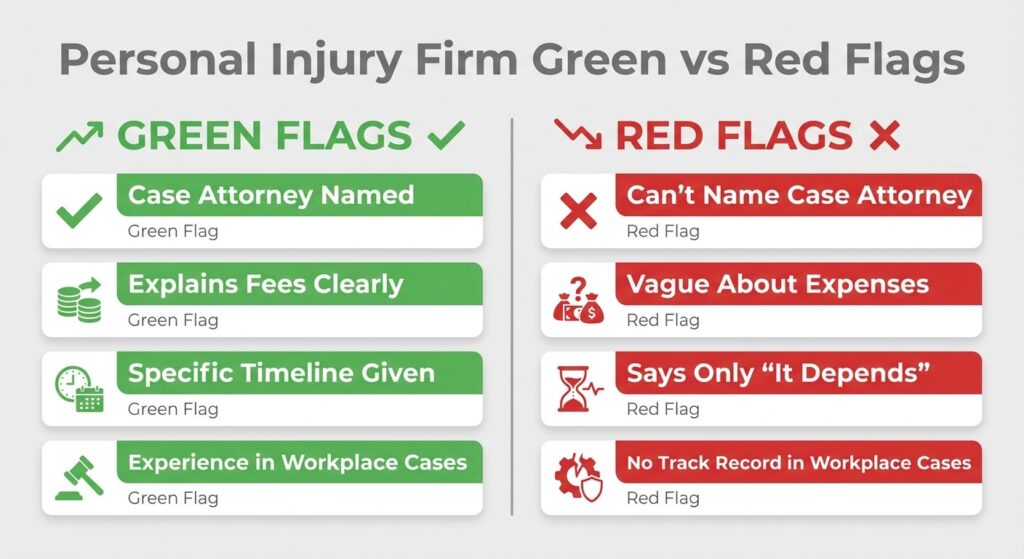
A Quick Reference: Green Flags vs. Red Flags
| Green Flag | Red Flag |
|---|---|
| Tells you the case attorney’s name before you sign | Can’t tell you who will actually work your file |
| Explains contingency fees in plain language | Vague or evasive about how expenses are handled |
| Answers timeline questions with specifics | Says “it depends” and stops there |
| Welcomes questions about switching attorneys | Gets defensive when you ask about your options |
| Multiple reviews mention communication quality | Pattern of reviews mentioning unreturned calls |
| Verifiable track record in workplace cases | Advertises broadly but can’t cite relevant experience |
Your Next Step Starts With One Honest Conversation
You don’t need to know every detail of Kansas workers’ compensation law before you call a lawyer. You don’t need your paperwork organized or your story perfectly rehearsed.
What you need is to walk into that first conversation knowing you’re allowed to ask direct questions and expect direct answers.
The attorney who signs you up and the attorney who works your case may be two different people. That’s fine—as long as you know who the second person is, what their track record looks like, and how they’ll treat you when the insurance company is playing hardball and your bills aren’t waiting.
You’re not being difficult by asking. You’re being smart. And in my experience, the firms worth hiring will respect you more for it.